
Open Water

Where do you go to remember yourself?
I almost always end my summer swims the same way.
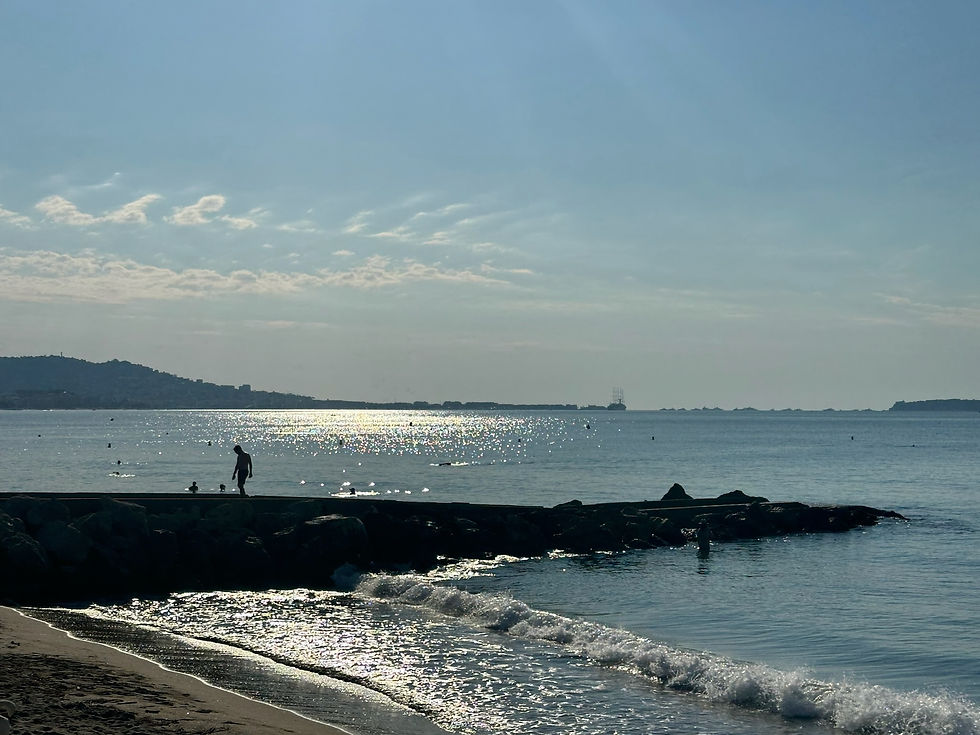
I float on my back for a few quiet moments before turning toward shore. Then a few slow breaststroke pulls, just enough to slow my breath and soak it all in: the many shades of green climbing the mountains, the azure blues that blur the line between sea and sky, and the tiny flecks of gold dancing in the water. Somehow even my sun-bronzed skin becomes part of the color palette.
In those few minutes, I feel complete clarity and, honestly, I can't think of anywhere else I'd rather be.

Nager en Liberté
It wasn't until I picked up an issue of Madame Figaro and came across an article titled Nager en Liberté — swimming in freedom — that I began thinking about something I’ve been doing, and loving, for years.

Every time I'm in France, I indulge in one of my oldest guilty pleasures: picking up the latest weekly Madame Figaro. I still love a real magazine to hold, especially when next to the pool or beachside.
I seriously read it cover to cover.
As an impressionable seventeen-year-old exchange student caught somewhere between romanticizing the language and adoring this country, I also fell in love with this magazine. It helped me improve my French because every page genuinely interested me.
Looking back, many of those articles quietly planted seeds that would eventually grow into a thirty-year career in nutrition and wellness, helping myself and others vivre pleinement — live fully.
This latest issue featured an article on open-water swimming — natation en eau libre — and somewhere between the first paragraph and the last, I found myself nodding along with more than a few ahas.
The author compared swimming laps in a pool to running on a track, while swimming in open water was more like trail running.
I've known about the flow state the author mentioned for years, but I'd never thought of the sea as the trail run of the swimming world. The comparison instantly clicked.
Years ago, before a hamstring injury—and perhaps a little wisdom granted with age—told me that running simply wasn't the best fit for my body anymore, I loved trail running. Out on winding dirt paths or in the mountains, I felt free. Energized. Like a Nike commercial where every stride was effortless. Put me on a track to run laps or drills? I understood the purpose, but my heart was never really in it.
Swimming in a pool vs. the ocean has become much the same.
Pools absolutely have their place. If you know our family, you know we spend plenty of time in them. Living in Portugal means wetsuits, neoprene caps, and convincing myself the Atlantic isn't that cold. But if I'm honest, I'm a fair-weather swimmer at heart.
Maybe it goes back to those early mornings when my sister and I dragged ourselves out of bed before sunrise for Sunset Swampers swim team practice, diving into cold water while most of the neighborhood was still asleep.
The Mediterranean in Summer...

Is something altogether different.
The warm water here in the South of France catches the light in such a way, creating glimmers of tiny flecks of gold scattered like the inside of a snow globe. We’ve always called it “magic water.” And it isn't just blue. It's every imaginable shade of azure, changing by the minute as the sun shifts throughout the day. If you've never seen it, you'll simply have to come and experience it for yourself.
The moment I enter the water and leave the shore, something changes.
The noise fades.
Not just the sounds around me, but the ones inside my own head.
There are no podcasts. No notifications. No conversations. Just the rhythm of my breathing, the gentle rise and fall of the swell, the crackle of the water around my ears, and the unmistakable smell and taste of salt.
Somewhere between the shoreline and the horizon, I stop trying to think.
And that's usually when my best thinking begins.

Flow.
Natation en eau libre — open-water swimming — is a place I find it.
That beautiful state where time softens, self-consciousness disappears, and you're completely immersed in what you're doing. Athletes experience it. Artists know it. Musicians, writers, gardeners, potters, woodworkers, photographers, cooks—they've all found their own doorway into it.
Or perhaps you've found yours while baking on a Sunday afternoon, restoring an old car, tending tomatoes in the garden, or quietly walking your dog before the rest of the world stirs.
We all arrive there by different paths.

Rethinking Meditation
And perhaps that's why this article stayed with me long after I put the magazine down.
While in this state during a swim, the idea of meditation surfaced. One of my favorite conversation topics and practices to teach clients.
"I've tried it."
"It doesn't work."
"I can't sit still."
"My mind just won't stop."
I hear some version of those words almost every week.
Perhaps meditation doesn't always ask us to sit still.
Perhaps sometimes it asks us to move.

The research continues to show that even short mindfulness practices—as little as ten minutes—can positively influence our stress response, attention, emotional regulation, and overall well-being. But somewhere along the way, we've unintentionally made meditation feel far more complicated than it needs to be.
As someone who spends much of her professional life helping people understand their unique blueprint and how to work with it — not against it — I've come to appreciate that there isn't one doorway into this experience.
Some minds and bodies settle through stillness. Others settle through rhythm and movement. Some personalities need silence before they can hear themselves. Others need to move before they can become still. For many people, movement isn't a distraction from presence—it can actually become the pathway toward it.
One of the things I love most about personalized health is watching people stop trying to meditate like everyone else and begin discovering the practices that fit them and their nervous system instead.
For one person, it's sitting quietly, staring at a candle or holding a cup of tea.
For another, it's hiking.
Gardening.
Cooking.
Playing the piano.
Throwing clay on a pottery wheel.
Writing.
Painting.
Swimming.
Years ago, I read a story from Buddhist monk Thích Nhất Hạnh where he described two ways of washing dishes: washing them simply to get them done so you can move on to what comes next, or washing the dishes simply to wash the dishes and be present in the moment. To actually be there for the warm water, the movement of your hands, the ordinary task in front of you.

I think about that when doing some of my repeated daily to-dos. Instead of rushing through another pile of clothes to fold, I remind myself that I get to fold these clean clothes for myself and the people I love. Same laundry. Different perspective.
Life is happening while washing the dishes and doing the laundry. It’s like a morning yoga practice or my swim—it isn’t something I do before the day begins. It is a part of the day. Part of life. Making even the ordinary become just a little more sacred.
All a part of the rich ritual.
A Lifelong Thread
Looking back, water has been quietly shaping my life all along. (I’m also a Pisces, if that sheds any light on this piece of my puzzle.)

Swimming carried me through childhood, high school, triathlons, masters swimming, years of coaching, and now these quiet mornings in the sea. Even though I wasn’t planning to swim collegiately, I trained with high school mates who were, in order to be the strongest and best possible. To work harder, dig deeper, and discover I was capable of more than even I knew. Swimming became the strongest leg of every triathlon I ever raced and is a constant thread woven through my life.
When our girls were little, they both began their love for the water by playing in the bathtub and pool, receiving more structured lessons at an early age with Infant Swimming Resource. Like many parents, we wanted them to develop love and respect for the water as well as that instinctive ability to find air and survive should they ever, God forbid, find themselves in the water without supervision. It wasn't about creating competitive swimmers. It was about learning to have fun and also giving them the best chance should the unthinkable ever happen.

A natural transition from summer swim league by age three to childhood careers in year-round competitive swimming blossomed. My eldest daughter swam her final race at the London Aquatics Centre, where the 2012 Olympics were held, last winter. And now my youngest daughter, wrapping up her last year of IB and swimming, will compete at the Nationaal Zwemcentrum de Tongelreep in Eindhoven, Netherlands, later this winter. Both are incredibly impressive venues. Nothing new to them. At five and six years old, they stood on the block at the Georgia Tech Aquatic Center, where the 1996 Olympics in Atlanta, Georgia, were held.
Watching them now, I don't see races or podiums. I see what all of these moments in the pool and open water have offered them — confidence, resilience, strength, calm under pressure.
A lifelong gift that swimming has turned out to be.
Bringing Each Other to the Water
Swimming — be that in a pool or open water — has been my way to connect and socialize in a healthy way throughout my entire adult life as well.
A co-worker and dear friend to this day, Erin, and I held each other accountable with early morning ocean swims before work. California coast. Cold Pacific Ocean. Thick kelp forests. Murky visibility. The occasional reminder that yes... there might be sharks somewhere beneath us. Those swims became part workout, part therapy, and, looking back now, a moving meditation long before I had words for it.
Then there were “poolside therapist” and summer "granny swims" with my dear German friend Tanja. Somehow our conversations always met around bigger questions—how life changes us, what we're learning, and what we're letting go of. These swims, not so much about the distance or the training effect. They're more about showing up for one another in a consistent way.
Every morning in Portugal and in the South of France, we see people thirty years older than us making their way into the open waters.

Former President of Portugal Marcelo Rebelo de Sousa can be seen swimming from our local Praia dos Pescadores, rain or shine.
People of all ages are training for Ironman, and many are off to swim remarkable distances. Others simply move gently through the water together, with the post-swim reward of a thermos of coffee and a chat with friends. There is one couple, approaching ninety, who continues to inspire me every summer. Their swims are no longer about speed, but they do go the distance together. Their swims are about dedication and devotion—to movement, to health, and perhaps most beautifully, to one another.
This morning, after our swim, my husband and I crossed paths with another couple waist-high in the water. The husband is living with dementia. Being in the open water is one of the places where they can still share something joyful and peaceful together.
We exchanged a few simple words that left an imprint on our hearts before heading for our coffee and towels. As we waded our way back toward shore, my husband and I quietly honored something between ourselves.
Whatever our final season looks like...We'll keep bringing each other to the water.
As summer wraps up, I'll slip back into the Med one more time before I leave. When I turn toward shore, I'll float on my back for a few quiet moments.
Take a few slow breaststroke pulls.
Take in the green of the mountains.

The azure blues.
The tiny flecks of gold dancing in the water.
Connect to the place where the noise fades.
The place where I remember myself.
Nager en liberté.
So I'll leave you with the same question I've been asking myself ever since I folded the magazine closed.
Where do you go to remember yourself?


Comments