
More Than a Blue Zone

Recently, I read an article in The New Yorker exploring the growing debate around Blue Zones—the regions of the world long celebrated for producing extraordinary numbers of centenarians.
Questions have been raised about some of the original data, from incomplete birth records and census inconsistencies to pension fraud that may have inflated the number of people believed to be living well beyond one hundred. Other researchers continue to stand behind much of the longevity data.
Good science should be willing to keep asking questions and revisit what we think we know.
As I finished the article, I found myself wondering if the question should be “Did they really live to 100 or 110?” but instead, “How were they living to the end?”

Years ago, I worked at Loma Linda University Medical Center, a community that would later become synonymous with the Blue Zones movement. Since then, life has taken me to many places where food, movement, family, community and the natural environment are simply woven into daily life—through my French family, our life in Portugal and decades of returning to Greece and its islands.
I don’t always travel looking specifically for longevity secrets, but I have always paid attention.
Amorgos
I just returned from Amorgos, where I was once again teaching and assisting on retreat with my mentor and dear friend Sheila of Seek Yoga & Travel.

Amorgos has worked its way into my heart over the years. Returning there has become part of my own rhythm—a chance to step away from the usual noise and remember some of my bigger why, building up resources to process and an opportunity to practice and just be with intent.
On Amrogos, you can’t help but notice how people live there.
Older men and women are still walking through villages and up and down stone steps that would qualify as a workout in most of our lives. People walk from village to village. Donkeys are still used to move through places where cars can’t go. Gardens are tended. Food is grown, gathered, prepared and shared.
Movement isn’t necessarily scheduled. It’s part of living.
One of the people I always look forward to seeing is my friend Vangelis of IAMA, whose small distillery creates products from herbs, plants and flowers gathered by hand on the island.
What fascinates me is not simply what he makes, but how.

Plants and flowers are gathered according to the season, the landscape and even the phases of the moon. Local people come together to harvest, carrying forward knowledge and traditions passed from one generation to another.
There is science within many of these traditions. But there is also something more difficult to quantify: a relationship with place.
It's the same belief at the heart of the Yoga Teacher Training I'm co-teaching with Sheila in Scotland next year: different landscape, same understanding that where we practice shapes how we practice.
France
I’ve experienced that in France too.

For years, we sourced olive oil from the old Moulin d’Opio, where families from the surrounding area brought their olives after harvest. Some had their own oil pressed. Others contributed their olives to the mill’s production.
I used to pour that olive oil generously over my summer salads and imagine all the hands and all the land surrounding the very table where I was sitting.
Of course I appreciate the polyphenols and healthy fats. I’m a dietitian; those things are important to me.
But I also thought about the trees, the harvest, the pressing, the families and the history contained in that bottle.
Food has always felt bigger than nutrition to me.
And then there are the figs.
Anyone who has followed me for a while knows I could tell my fig story every year. Their arrival has become one of my own markers of summer, a reminder that nature has its own calendar and asks very little of us except that we notice.

Maybe that’s part of what I’ve been paying attention to all these years.
Not only what people eat, but how they move. How much time they spend outside. How connected they are to the place where they live. How often generations mix. How meals are shared. How much of everyday life still happens in community rather than alone.
I first learned some of this from my French host families when I came here as a seventeen-year-old exchange student.
Meals weren’t something squeezed into the day. They were where the day slowed down. Conversation unfolded. Children listened to adults and adults listened to children.
The table wasn’t something to fit into life. It was part of how life was lived.

Years later, my husband’s family welcomed me into that same rhythm. My girls still remember their Papy buzzing through the village on his blue Vespa to pick up fresh fish for dinner—and perhaps even more fondly, his contribution to dessert. A tarte tropézienne, of course, proudly brought home and placed in the middle of the table for everyone to share.
And just this past weekend, we were back in France for our nephew’s beautiful wedding.
It struck me all over again.
Every hors d’oeuvre, every plate of food and every glass of wine was beautifully prepared, paired, presented and, importantly, appreciated.
There was time between courses. Time for conversation. Time to notice what was being served and who was sitting beside you. The celebration stretched from the day well into the night, and no one seemed particularly interested in rushing through any of it.
Those experiences have very little to do with calories.
They have everything to do with nourishment and belonging.
The Equinox
And now, almost perfectly, the equinox has arrived.
Summer’s abundance begins giving way to autumn. The light changes. Our foods change. Our schedules change. Nature shifts, and we can too.

There are seasons when we need more structure and seasons when we need more space. Times to gather and times to turn inward. Times to push a little and times to listen.
After nearly thirty years working in health and well-being, I’m still fascinated by the science. Genetics, biomarkers and personalized nutrition can give us extraordinary insight into our own biological story.
But my work has also taught me to look beyond the numbers.
At movement and strength. Sleep and light. Stress and recovery. The nervous system. Our environment. Relationships. Purpose. The food available to us and the people we eat it with. The rhythms we repeat every day without ever thinking of them as a “health practice.”
All of it is information.
Awaken
Next week I’ll head back to Greece, this time to the Peloponnese for our Awaken retreat. Amanda and I will go much deeper into the science and tools there, helping each person better understand their own biology and what their individual results may be telling them.

But we’re also stepping away from everyday life long enough to listen.
To move. To eat together. To experience a different landscape and culture. To have conversations we might not make room for at home. To take all of that information and ask what it actually means for the way we want to live.
Because health can become surprisingly small when we reduce it to metrics alone.
Protein grams, glucose responses, sleep scores, supplements, biological age, genetics—all can offer valuable information.
They are tools. They are not the whole story.
This summer I said yes to fruit straight from the tree, tomatoes that only taste this good for a few fleeting weeks, dinners that stretched late into the evening, swimming in the sea, walking unfamiliar paths and spending time around tables with people I love.
Now autumn is asking something different of me. (If you feel that pull too, Seasonal Living: The Autumn Season is available now.)
Perhaps that is the real lesson I’ve carried home—not from a Blue Zone, but from the people and places and the practices.
There is no one perfect diet. No magical food. No single protocol for a long and meaningful life.
There is our biology, certainly.
But there is also how we move through our days. Season and place. Culture and environment. Strength and rest. Purpose, pleasure, connection and belonging.
The science helps us understand more of the story but then we have to go live it.
That is also what I love about the work we’re doing with Awaken. We can look closely at the science without losing sight of the person living inside it.
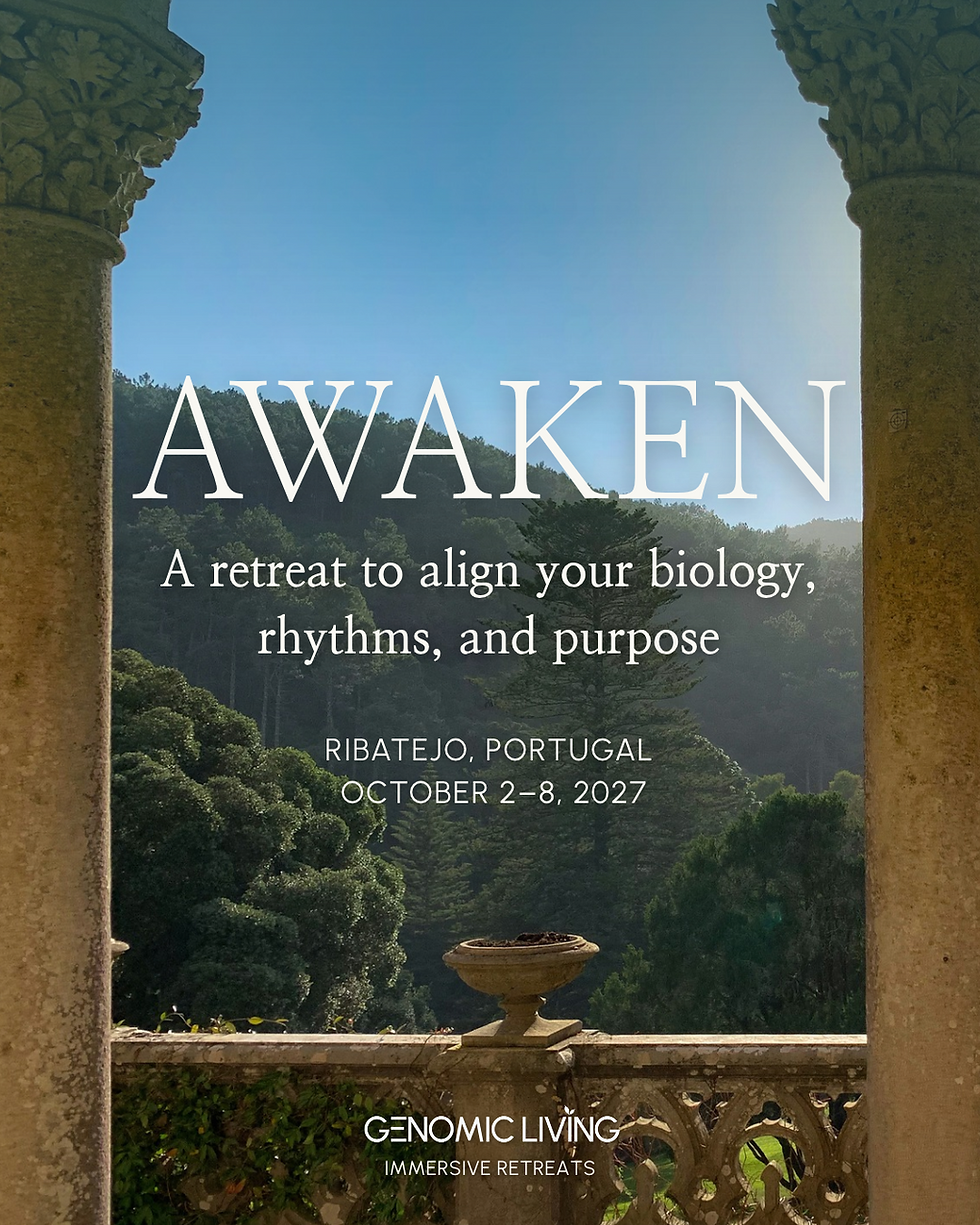
Next week, we’ll do exactly that in the Peloponnese. And next autumn, we’ll return to Portugal for Awaken 2027—another opportunity to step away from the usual rhythms for a while, listen more closely and explore what living well can look like in your own life.
For now, I’m welcoming autumn.


Comments